
What Are Sulawesi Shrimp?
Sulawesi shrimp are among the most exotic and challenging freshwater shrimp in the aquarium hobby. They originate from the ancient tropical lakes of Sulawesi, Indonesia: Lake Matano, Lake Poso, and Lake Towuti. These lakes formed millions of years ago, creating isolated ecosystems where unique species evolved found nowhere else on Earth.
The ancient isolation of these lakes means Sulawesi shrimp have developed highly specialized requirements. They thrive in conditions that would kill most other aquarium shrimp: high pH, warm temperatures, and alkaline water chemistry that mirrors their native lakes.
Why Sulawesi Are Special
Several factors make Sulawesi shrimp remarkable:
- Endemic species: Found only in a few Indonesian lakes
- Ancient lineage: Evolved in isolation for millions of years
- Unique appearance: Stunning colors and patterns unlike any other shrimp
- Conservation concern: Wild populations face habitat threats
- Ultimate challenge: Represent the pinnacle of shrimp keeping difficulty
If you’ve mastered Neocaridina and want something more challenging than Caridina, Sulawesi represent the final frontier of freshwater shrimp keeping.
The Critical Warning You MUST Understand
Sulawesi requirements are THE COMPLETE OPPOSITE of Caridina Bee shrimp.
This is the most common and deadly mistake made by hobbyists:
- You master Neocaridina (easy)
- You successfully keep Caridina Bee shrimp (intermediate)
- You assume “advanced” Sulawesi need similar care to “intermediate” Caridina
- You add Sulawesi to your Caridina setup
- They die within days
Sulawesi vs Caridina Bee - Opposite Requirements:
| Parameter | Caridina Bee | Sulawesi |
|---|---|---|
| pH | 5.8-6.8 (acidic) | 7.5-8.5 (alkaline) |
| Temperature | 68-74F (cool) | 78-84F (warm) |
| KH | 0-1 dKH | 3-6 dKH |
| Substrate | Active (buffering) | Inert ONLY |
| Remineralizer | GH+ | Sulawesi Mineral 7.5/8.5 |
If you currently keep Caridina successfully, you cannot add Sulawesi to that tank. You need a completely different setup.
Sulawesi vs Caridina Bee: The Critical Differences
Understanding why these differences exist helps prevent deadly mistakes.
Why Are Requirements Opposite?
Evolutionary environment:
Caridina Bee shrimp evolved in cool mountain streams with:
- Soft, acidic water from leaf litter decomposition
- Low mineral content
- Cool temperatures from high elevation
- Acidic conditions (pH 5.5-6.5)
Sulawesi shrimp evolved in ancient tropical lakes with:
- Alkaline water from limestone geology
- Higher mineral content
- Warm equatorial temperatures
- Basic conditions (pH 7.5-8.5)
Common Mistake: “Advanced Means Similar”
Many hobbyists assume:
- Beginner = Neocaridina
- Intermediate = Caridina
- Advanced = “More demanding Caridina”
This is wrong. “Advanced” refers to care difficulty, not parameter similarity. Sulawesi are advanced because they’re sensitive and specific, not because they’re “more Caridina.”
The Equipment You Need Is Different
| Equipment | Caridina Setup | Sulawesi Setup |
|---|---|---|
| Substrate | Active (ADA Amazonia) | Inert (crushed coral, aragonite) |
| Remineralizer | Salty Shrimp GH+ | Salty Shrimp Sulawesi Mineral 8.5 |
| Heater setting | 70-72F | 80-82F |
| pH target | 6.0-6.5 | 7.8-8.2 |
All Sulawesi Species (Ranked by Difficulty)
Not all Sulawesi species are equally difficult. Here’s a comprehensive ranking from most accessible to most challenging:
Easiest Sulawesi Species
Blue Leg Poso (Caridina caerulea)
Blue Leg Poso shrimp are considered the easiest Sulawesi species and the best starting point for hobbyists new to this group.
Origin: Lake Poso
Parameters:
- pH: 7.0-8.5
- Temperature: 80-84F (27-29C)
- TDS: 150-250 ppm
- GH: 6-8 dGH
- KH: 3-6 dKH
Difficulty: Moderate (easiest Sulawesi overall)
Description: Transparent body with distinctive blue coloration on their legs. Their understated beauty appeals to many keepers. Blue Leg Poso are more tolerant of parameter fluctuations than other Sulawesi species.
Why start here: More forgiving of beginner mistakes, slightly wider parameter tolerance, and generally more available than other species.
Six Banded / Matano Tiger (Caridina holthuisi)
Six Banded shrimp, also known as Matano Tiger, feature distinctive tiger striping patterns that make them visually striking.
Origin: Lake Towuti
Parameters:
- pH: 7.5-8.5
- Temperature: 77-86F (25-30C)
- TDS: 150-250 ppm
- GH: 6-8 dGH
- KH: 3-6 dKH
Difficulty: Moderate
Description: Clear or slightly colored body with bold dark stripes resembling tiger markings. The pattern varies between individuals, with some showing more pronounced stripes than others.
Moderate Difficulty
Cardinal Shrimp (Caridina dennerli)
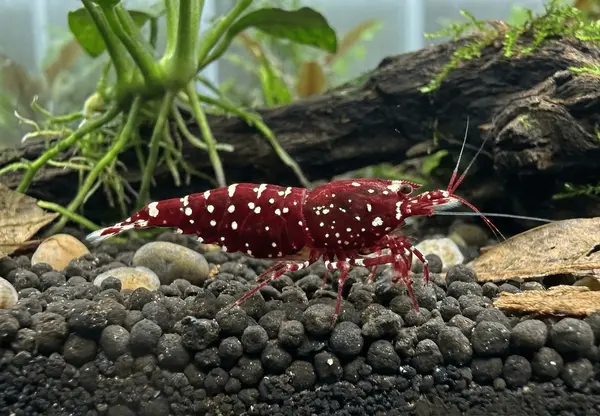
Cardinal Shrimp are the most iconic Sulawesi species, instantly recognizable by their stunning red bodies covered in white spots.
Origin: Lake Matano
Parameters:
- pH: 7.8-8.2
- Temperature: 77-86F (25-30C)
- TDS: 150-250 ppm
- GH: 6-8 dGH
- KH: 3-6 dKH
Difficulty: Hard (but easiest of the “hard” species)
Description: Deep red body adorned with bright white spots. Often described as looking like tiny ladybugs. Cardinals are the species most people think of when they hear “Sulawesi shrimp.”
Why they’re popular: Despite their difficulty, Cardinal Shrimp are the most commonly kept Sulawesi species because their appearance is so striking. If you want the iconic Sulawesi experience but are willing to invest in proper care, Cardinals are the choice.
White Orchid / Starry Night (Caridina poso)
White Orchid shrimp display white spots on a transparent or slightly blue-tinted body, creating an ethereal “starry night” appearance.
Origin: Lake Poso
Parameters:
- pH: 7.8-8.4
- Temperature: 80-84F (27-29C)
- TDS: 150-250 ppm
- GH: 6-8 dGH
- KH: 3-6 dKH
Difficulty: Hard
Description: Delicate white spotting on a translucent body. Some specimens have a subtle blue or tan tint. The pattern resembles a starry night sky, hence the alternative name.
Difficult Species
Yellow Nose / Gold Flake (Caridina spinata)
Yellow Nose shrimp are named for their distinctive yellow rostrum (the spike between their eyes), often accompanied by gold flake markings on their body.
Origin: Lake Towuti
Parameters:
- pH: 8.0-8.5
- Temperature: 82-84F (28-29C)
- TDS: 180-250 ppm
- GH: 6-8 dGH
- KH: 4-6 dKH
Difficulty: Hard
Description: The yellow rostrum is the identifying feature, combined with subtle gold or bronze flakes scattered across the body. Requires higher pH and temperature than some other Sulawesi species.
Harlequin (Caridina spongicola)
Harlequin shrimp are the smallest Sulawesi species and among the most challenging to keep.
Origin: Lake Towuti
Parameters:
- pH: 7.0-8.5
- Temperature: 78-85F (26-29C)
- TDS: 150-250 ppm
- GH: 6-8 dGH
- KH: 3-6 dKH
Difficulty: Very Hard
Description: Tiny shrimp with black and red coloration creating a harlequin pattern. In the wild, they live on freshwater sponges, which gives them their scientific name (spongicola means “sponge dweller”).
Special considerations: Their small size makes them extremely vulnerable. They have very specific habitat requirements and often struggle to thrive even when parameters are correct.
Large Harlequin (Caridina woltereckae)
Large Harlequin shrimp are the larger cousin of the standard Harlequin.
Origin: Lake Towuti
Parameters:
- pH: 8.0-8.5
- Temperature: 81-84F (27-29C)
- TDS: 180-250 ppm
- GH: 6-8 dGH
- KH: 4-6 dKH
Difficulty: Very Hard
Description: Similar coloration to standard Harlequin but larger. Still extremely challenging to maintain in captivity.
Expert Only
Red Line / Peppermint (Caridina striata)
Red Line shrimp are considered the most difficult Sulawesi species to keep alive in captivity.
Origin: Lake Towuti
Parameters:
- pH: 8.0-8.5
- Temperature: 81-84F (27-29C)
- TDS: 180-250 ppm
- GH: 6-8 dGH
- KH: 4-6 dKH
Difficulty: Extremely Hard
Description: Beautiful red striping pattern on a lighter body, sometimes described as “peppermint” coloring. Their striking appearance is matched by their extreme sensitivity.
Warning: Red Line shrimp should only be attempted by experienced Sulawesi keepers who have successfully maintained other species for extended periods. Even then, success is not guaranteed.
Species Difficulty Summary
| Rank | Species | Difficulty | Best For |
|---|---|---|---|
| 1 | Blue Leg Poso | Moderate | Beginners to Sulawesi |
| 2 | Six Banded | Moderate | Beginners to Sulawesi |
| 3 | Cardinal Shrimp | Hard | Those wanting iconic species |
| 4 | White Orchid | Hard | Intermediate Sulawesi keepers |
| 5 | Yellow Nose | Hard | Intermediate keepers |
| 6 | Harlequin | Very Hard | Experienced keepers only |
| 7 | Large Harlequin | Very Hard | Experienced keepers only |
| 8 | Red Line | Extremely Hard | Expert keepers only |
Water Parameters
Why Sulawesi Parameters Are Unique
The ancient lakes of Sulawesi have specific mineral compositions created by millions of years of geological processes. The limestone-rich geology creates alkaline conditions very different from most freshwater environments.
Sulawesi shrimp evolved to:
- Thrive in alkaline water (pH 7.5-8.5)
- Tolerate warm tropical temperatures (78-84F)
- Utilize specific mineral ratios found in their native lakes
- Depend on the unique microbial communities in these ecosystems
TDS for Sulawesi
Target Range: 150-250 ppm (optimal 180-220 ppm)
| TDS Range | Assessment |
|---|---|
| Below 120 ppm | Too low, mineral deficiency |
| 150-250 ppm | Optimal range |
| 250-300 ppm | Acceptable |
| Above 300 ppm | May cause stress |
Interestingly, Sulawesi TDS requirements are similar to Neocaridina, but the mineral composition is completely different. You cannot use Neocaridina water for Sulawesi.
For detailed information, see our TDS parameter guide.
GH for Sulawesi
Target Range: 6-8 dGH (optimal 6-7 dGH)
| GH Range | Assessment |
|---|---|
| Below 5 dGH | Too low |
| 6-8 dGH | Optimal |
| 8-10 dGH | Acceptable |
| Above 10 dGH | May cause issues |
Calcium and magnesium are essential for healthy molts. The Sulawesi Mineral remineralizer provides the correct ratio of these minerals.
For detailed information, see our GH parameter guide.
KH for Sulawesi
Target Range: 3-6 dKH (optimal 4-5 dKH)
| KH Range | Assessment |
|---|---|
| Below 2 dKH | Too low, pH unstable |
| 3-6 dKH | Optimal |
| 6-8 dKH | Acceptable |
| Above 8 dKH | Generally unnecessary |
Critical difference from Caridina: While Caridina Bee shrimp need 0 KH, Sulawesi require KH to maintain their high pH. This is a fundamental difference that cannot be ignored.
For detailed information, see our KH parameter guide.
pH for Sulawesi
Target Range: 7.5-8.5 (optimal 7.8-8.2)
| pH Range | Assessment |
|---|---|
| Below 7.0 | Too acidic, stress and death |
| 7.5-8.5 | Optimal range |
| Above 9.0 | Too alkaline |
Why high pH matters: Sulawesi evolved in alkaline lake water. Their gill ion exchange, enzyme systems, and metabolic processes are optimized for basic conditions. Acidic water disrupts these fundamental biological processes.
For detailed information, see our pH parameter guide.
Temperature for Sulawesi
Target Range: 77-86F (25-30C) optimal 78-84F (26-29C)
| Temperature | Assessment |
|---|---|
| Below 75F (24C) | Too cold, metabolic stress |
| 77-86F (25-30C) | Optimal range |
| 78-84F (26-29C) | Ideal sweet spot |
| Above 88F (31C) | Risk of overheating |
Critical difference from other shrimp: While Neocaridina prefer 70-76F and Caridina prefer 68-74F, Sulawesi need temperatures that would stress or kill other species. This is not optional; it’s a biological requirement.
Temperature stability is crucial: Fluctuations stress Sulawesi more than many other shrimp. Use a reliable, adjustable heater and consider a heater controller for backup.
For detailed information, see our temperature parameter guide.
Tank Setup Requirements
Absolute Requirements
Certain elements are non-negotiable for Sulawesi success:
RO/DI Water
Why required: Lake Sulawesi water chemistry cannot be replicated with tap water. You need pure water that you can remineralize precisely.
Target: 0-5 TDS from your RO system before adding remineralizer.
Sulawesi-Specific Remineralizer
The only acceptable options:
- Salty Shrimp Sulawesi Mineral 8.5: For most species (Cardinal, Yellow Nose, Harlequin, Red Line)
- Salty Shrimp Sulawesi Mineral 7.5: For some Lake Poso species (Blue Leg Poso, some White Orchid populations)
Important note about Sulawesi Mineral 8.5: This product requires special preparation:
- Add powder to RO water
- Inject CO2 or let sit open for 3-4 days (the mineral needs CO2 to dissolve completely)
- Aerate thoroughly before use (to remove excess CO2)
Do NOT use:
- Salty Shrimp GH/KH+ (wrong mineral composition)
- Salty Shrimp GH+ (too low pH, wrong composition)
- Any Caridina or Neocaridina remineralizer
Inert Substrate ONLY
Critical: Do NOT use active/buffering substrates (ADA Amazonia, Fluval Stratum, etc.). These will crash your pH and kill Sulawesi.
Recommended substrates:
- Crushed coral (helps maintain alkaline pH)
- Aragonite sand (also buffers toward alkalinity)
- Lava rock
- Bare bottom (acceptable but less aesthetic)
These substrates either remain neutral or help maintain the high pH Sulawesi need.
Reliable Heater
Sulawesi require higher temperatures than most aquarium inhabitants. You need:
- Adjustable heater (50-100W depending on tank size)
- Set to 80-82F for most species
- Consider a heater controller as backup
- Monitor temperature daily initially
Recommended Tank Setup
10-20 gallon tank
|-- Substrate: Crushed coral / aragonite mix (1" depth)
|-- Filter: Dual sponge filter
|-- Heater: Adjustable 100W (set to 80-82F)
|-- Lighting: Moderate (8-10 hours for algae growth)
|-- Hardscape: Lava rock, dragon stone (NO driftwood)
|-- Plants: Java Moss, Anubias (optional)
|-- Water: RO + Salty Shrimp Sulawesi Mineral 8.5Notes:
- Avoid driftwood: It releases tannins that lower pH
- Lava rock and dragon stone are pH-neutral or slightly alkaline
- Java Moss provides cover for babies but isn’t required
- Moderate lighting encourages algae growth (natural food source)
Tank Maturation is CRITICAL
Minimum maturation: 2-3 months after cycle completes
Ideal maturation: 4-6 months with established biofilm and algae growth
Sulawesi failures often come from impatience. These shrimp evolved in ancient, stable ecosystems. They don’t handle new, unstable tanks well. The tank needs time to develop:
- Stable bacterial colonies
- Natural biofilm on surfaces
- Algae growth (their primary food in nature)
- Consistent parameters without fluctuation
Colony Size Matters
Recommended starting colony: 15-25+ individuals
Sulawesi do best in larger groups. They display more natural behavior, breed more readily, and seem to have better survival rates in larger colonies. Starting with just 5-6 shrimp often leads to failure.
Feeding Sulawesi
Natural Diet
In their native lakes, Sulawesi graze on:
- Aufwuchs (organisms growing on rock surfaces)
- Algae
- Biofilm
- Microscopic organisms
A well-established tank should provide most of their nutritional needs naturally.
Feeding Guidelines
Frequency: Every 3-4 days at most
Amount: Tiny portions, consumed within 1-2 hours
Key principle: The tank should provide most nutrition. Supplemental feeding should be minimal.
Recommended Foods
Biofilm boosters (most important):
- Bacter AE
- SL-Aqua Milione
These products encourage biofilm growth rather than providing direct nutrition. In Sulawesi tanks, biofilm is more important than commercial foods.
Supplemental foods (sparingly):
- Spirulina wafers (crushed small)
- Glasgarten
- Borneo Wild
- Blanched vegetables (rarely)
Avoid:
- Heavy protein foods
- Large food portions
- Daily feeding
Overfeeding Risk
Overfeeding is even more dangerous in Sulawesi tanks than with other shrimp:
- Soft water = faster decomposition
- Warmer temperatures = faster bacterial growth
- Excess food = ammonia spikes = death
When in doubt, don’t feed. A healthy Sulawesi tank has enough natural food sources that your shrimp won’t starve.
Breeding Sulawesi
Why Breeding Is Difficult
Sulawesi are notoriously difficult to breed in captivity:
- Very specific parameter requirements: Less room for error than any other shrimp
- Lower fecundity: Fewer eggs per clutch (10-20) compared to Neocaridina (20-30)
- Longer gestation: Extended time carrying eggs
- Microscopic babies: Shrimplets are extremely small and vulnerable
- Low survival rates: Even experienced keepers lose many babies
- Slow reproduction: Population growth is much slower than other species
Prerequisites for Breeding
Before expecting breeding, ensure:
- Mature tank: Minimum 6 months old, ideally longer
- Stable parameters: Perfect parameters maintained for extended periods
- Large colony: 15-25+ individuals minimum
- Abundant biofilm: Primary food source for adults and babies
- Minimal disturbance: Avoid frequent tank maintenance
- Patience: Lots of it
Breeding Tips
Parameter stability is everything: Even small fluctuations can disrupt breeding. Sulawesi breed when they feel safe in a stable environment.
Avoid water changes while females are berried: Any parameter shift can cause egg dropping. Do water changes between clutches if possible.
Small water changes only: Maximum 10-15% when necessary, with exactly matched parameters.
Don’t rush: Breeding may not occur for 6-12 months after setup. This is normal.
Baby Survival
Sulawesi babies face significant challenges:
- Microscopic size: Extremely vulnerable to predation and filtration
- Slow growth: Takes longer to reach safe size
- High mortality: Expected even in ideal conditions
Maximize survival by:
- Using only sponge filters
- Maintaining abundant biofilm
- Dense moss or hiding spots
- Shrimp-only tank (mandatory)
- Not disturbing the tank
- Patience and acceptance of losses
Realistic Expectations
Even successful Sulawesi breeders experience:
- Long periods without breeding
- High baby mortality
- Slow population growth
- Occasional unexplained losses
If you want rapid population growth and easy breeding, Neocaridina are a much better choice. Sulawesi breeding is a long-term project requiring patience and dedication.
Common Problems and Solutions
Sudden Deaths
Most common cause: Parameter instability, especially temperature or pH swings.
Investigation steps:
- Check heater function immediately
- Test pH, GH, KH, TDS
- Verify temperature (use separate thermometer)
- Check for any equipment failures
- Review recent changes (water change, new additions, etc.)
Prevention:
- Use reliable heater with backup
- Monitor parameters twice daily initially
- Avoid frequent water changes
- Maintain consistent routine
For more details, see our Sulawesi sudden deaths guide.
Not Breeding After 6+ Months
Common causes:
- Tank not mature enough
- Colony too small (need 15+ individuals)
- Parameters not stable
- Too much disturbance
- Poor biofilm development
Solutions:
- Wait longer (breeding may take 12+ months)
- Add more individuals to the colony
- Reduce maintenance frequency
- Add Bacter AE to boost biofilm
- Verify all parameters are optimal
For more details, see our Sulawesi not breeding guide.
Deaths After Water Change
Cause: Parameter shock (Sulawesi are extremely sensitive)
Prevention:
- Maximum 10-15% water changes
- Match ALL parameters exactly (TDS, temperature, pH)
- Drip acclimate new water slowly over 1+ hours
- Only change water when absolutely necessary
pH Dropping
Causes:
- CO2 buildup (insufficient surface agitation)
- Insufficient KH
- Organic decomposition
- Driftwood in tank (should be removed)
Solutions:
- Increase aeration and surface agitation
- Verify KH is 3-6 dKH
- Remove any driftwood
- Check for excess organic matter
Frequently Asked Questions
See the FAQ section in the sidebar for the 8 most common questions about Sulawesi care.
Track Your Sulawesi with ShrimpKeeper
Sulawesi require the most precise, stable parameters of any freshwater shrimp. With specimens costing $15-50+ each and colonies requiring 15-25+ individuals, the investment is significant. Don’t leave success to chance.
The ShrimpKeepersapp provides the precision tracking Sulawesi demand.
Features built for Sulawesi keepers:
- Sulawesi-specific parameter ranges with instant feedback
- Temperature stability monitoring with trend alerts
- pH tracking to detect substrate issues early
- Remineralization calculator for Sulawesi Mineral 7.5 and 8.5
- Historical graphs to identify parameter drift before problems occur
- Tank maturation tracking to know when conditions are stable
Your Sulawesi deserve meticulous care. ShrimpKeepershelps you provide it.
Download ShrimpKeeper and give your Sulawesi the precision monitoring they need.
Related Guides
Explore the full spectrum of shrimp keeping:
-
Neocaridina Shrimp Care Guide: The beginner-friendly starting point. Hardy, colorful, and forgiving of mistakes. Perfect for learning shrimp keeping fundamentals.
-
Caridina Shrimp Care Guide: The intermediate challenge. Requires RO water and active substrate with OPPOSITE parameters from Sulawesi. Don’t confuse the two!
Important reminder: Sulawesi and Caridina Bee have opposite requirements. Success with one does not transfer to the other. Treat each as a completely separate learning journey.
This guide synthesizes information from scientific literature, manufacturer specifications (Salty Shrimp), experienced Sulawesi keeper communities, and academic resources on Lake Matano, Lake Poso, and Lake Towuti ecosystems. Water parameters have been verified across multiple authoritative sources specializing in Sulawesi shrimp care.
Frequently Asked Questions
Different evolutionary environments. Caridina evolved in acidic mountain streams; Sulawesi in alkaline tropical lakes. 'Advanced' refers to care difficulty, not parameter similarity.
Parameters are NOT similar enough. Sulawesi need higher pH (7.5-8.5), higher temp (78-84F), and specific mineral composition. Neocaridina survive but don't thrive in Sulawesi conditions.
Blue Leg Poso or Six Banded are most forgiving. Cardinal Shrimp if you want the iconic species but are prepared for extra challenge.
OPPOSITE requirements! Sulawesi need high pH (7.5-8.5), high temp (78-84F), KH 3-6, and inert substrate. Caridina need low pH, low temp, 0 KH, and active substrate.
Minimum 2-3 months after cycling. Ideally 4-6 months with established biofilm and algae growth.
No. Must use Sulawesi-specific remineralizer (Sulawesi Mineral 7.5 or 8.5) to recreate proper lake chemistry.
Endemic to specific Indonesian lakes, difficult to breed in captivity, challenging to keep alive during shipping, limited supply with high demand.
Optional but not required. Natural algae and biofilm on rocks are more important. Java Moss provides hiding spots for babies.
Track Your Parameters with ShrimpKeeper
Stop guessing. Start tracking. Our app gives you species-specific parameter ranges, instant diagnostics, and historical graphs.